Gantt Chart Microsoft Access
A recent project had me diving head first into creating charts in ASP.NET. Hoping to find a free alternative, I turned to the which provides a powerful set of tools to create a variety of chart types. One of the required charts was a simple Gantt chart, which we’ll be creating here using a stacked bar chart. This article assumes you have a working level knowledge of using the Microsoft Chart Controls. If you need help with the basics, there’s a good set of articles from Scott Mitchell. Using the Stacked Bar Chart A stacked bar chart, as the name implies, stacks different series of data on top of each other in a horizontal bar. The image below shows an example from the Chart Controls.
In the example above, there are four Series and each makes up part of each bar (light blue, orange, red, and dark blue). When points are added to each Series, an X and one Y value are provided (as opposed to some chart types, e.g. The range chart, which can take multiple Y values).

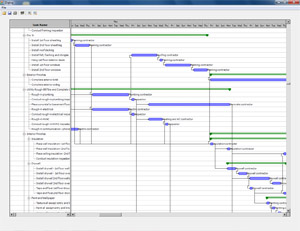
'How can I show a Gantt chart on my forms (or reports) using data in my database?' Here's one solution that uses the built-in chart control. Download Software Acer Iconia B1. Gantt Chart using the Microsoft Chart Control. If I wanted a sophisticated Gantt chart I'd use MS Project (hopefully I'd already be using MS Project if I was working with.
The X values in the various series are used to denote related data, i.e. Data with the same X values are stacked on top of each other. The axes for this chart are different from what you might expect from most other charts - the vertical axis represents the various X values, and the Y values are plotted along the horizontal axis. One important point to note is that the Y values are not the actual position of the end of that segment of the bar, instead they’re the width of that segment of the bar. In the example above, the values for the four series for bar #1 are 48, 5, 70, 70 - they are not 48, 53, 123, 193. Since only magnitudes are provided for the width of each bar segment, and not start/end points, all of the bars have a common starting point – a Y value of zero.
We’ll see later what this all means for our Gantt chart, where the Y axis is a series of dates. Creating the Chart For this example, we’ll work with a couple of simple project objects with a few properties – Name, Start, End, and PercentComplete.
1: 2: 3: 5: 7: 8: 9: 10: 11: 12: 13: 14: 15: 16: 17: 18: 19: Two Series are defined for this Chart. As was previously noted, all bars in a stacked bar chart will have the same starting point.
The projects we’re using, however, do not have the same start date. To work around this, the first Series (StartSeries) will simply be a placeholder so the project duration bars will start at the appropriate points. Its color is set to the same as the background so that it is not visible. The second Series (ProjectDurationSeries) will show the overall project duration, and is given some simple formatting (a green bar with a black 1 pixel border). There’s also some minimal formatting of the ChartArea: both the X and Y grids are disabled, and the date format is set to show month/year. As noted before, the horizontal axis is the Y axis, not the X axis (hence the date formal is applied to the LabelStyle of the Y axis). To plot the data, we’ll add a point to each Series for each project.
1: Chart1.Series[ 'StartSeries'].Points.AddXY(project1.Name, project1.Start); 2: Chart1.Series[ 'StartSeries'].Points.AddXY(project2.Name, project2.Start); 3: Chart1.Series[ 'ProjectDurationSeries'].Points.AddXY(project1.Name, project1.End); 4: Chart1.Series[ 'ProjectDurationSeries'].Points.AddXY(project2.Name, project2.End); 5: Chart1.DataBind(); The project names are used as the X values to relate the data for the two series, and these will end up as the labels on the X axis (the vertical axis). The Y values for StartSeries are the start dates for each project so that the duration bars start at the correct location.
For the ProjectDurationSeries, we’ll simply use the project end dates as the Y values (mostly to illustrate why this isn’t correct). The resulting Chart is shown below. Best Of Platinum Edition Dj Otzi Geboren Um Dich Zu Lieben on this page. From this we can see a few things. As noted before, the Y values (in this case the Start date) are plotted along the horizontal axis.
For each point we’ve added to the Series, a separate bar is created, with the vertical axis labels being the X values we provided – in this case the project name. We can also see that this Chart is is not quite what we’re looking for. Let’s examine how the Charts control is processing the data we’re providing to see why. When a DateTime is passed to the AddXY method, a couple of things happen.
First, the object type is used to set the XValueType/YValueType for the Series. In this case for the Y values, that’s ChartValueType.DateTime. The Chart control ultimately plots numbers, including DateTimes, as doubles.
To convert the DateTime to a double the method is used. This method returns a double that is the equivalent OLE Automation date, which represents the date as a floating point number with the integral values as days and an origin of midnight on December 29, 1899 (which is the origin of the Y axis in the above Chart – a the OLE Automation date of zero). Unfortunately, this means we’re not really plotting what we want. As an example, for Project 1, the Y value for StartSeries is 40238, which is the correct start date.
Because of the way the StackedBar chart is rendered, what we want for the ProjectDurationSeries Y value is the difference between the start and end dates. What we’re actually getting is the end date converted to a double, which is 40330, the difference between the end date and the origin of an OLE Automation date, which is why the bar extends to August 1, 2120 (the OLE Automation date for 40238 + 40330).
To solve this problem, we’ll make a few changes to the code. 1: 2: 3: 5: 7: 10: 11: 12: 13: 14: 15: 16: 17: 18: 19: 20: 21: 22: Since the second series is no longer plotting the full project duration, we’ve changed the name to ProjectCompleteSeries. We’ve also added a third series, ProjectRemainingSeries, and set a few formatting properties. Finally, we’ll make a few changes to the code.