Transcanada Hell Drivers
This Auto Hell Driver Video was provided. By Charlie Belknap's. Hollywood Stunt Show and produced. Tom Murphy & Associates, Inc. It is a large file but worth. Hell Drivers were big league celebrities with big. Saw a “blip” on the history channel last night and that brought the. Trans-Canada Hell Drivers; a.

By Leah Schnurr and Mica Rosenberg OTTAWA/NEW YORK (Reuters) - Canada's top court ruled on Friday that the World Bank did not need to turn over documents sought in a case against former employees of SNC-Lavalin accused of bribery, finding the international organization had immunity from the request. The case has been closely watched given its implications for how the World Bank investigates corruption and its ability to protect whistleblowers. The Supreme Court of Canada overturned a lower court order from 2014 that said the World Bank should release its investigative files for judicial review that could be relevant to the defense. By Michael Hirtzer CHICAGO (Reuters) - Quarterbacks went one-two at Thursday's NFL Draft as the Los Angeles Rams took Jared Goff with the first pick, and the Philadelphia Eagles followed suit by naming signal caller Carson Wentz with the second choice. It was the third time in the past five years that quarterbacks were taken with the first two picks of the National Football League Draft, a testament to the league's more wide open, pass-happy thrust with rules tailored to bolster scoring and foster player safety. For the Rams and their new quarterback it was a California dream come true.
Investigators are looking into whether Prince died from an overdose and whether a doctor was prescribing him drugs in the weeks before he was found dead at his home in suburban Minneapolis, a law enforcement official told The Associated Press. The official said Thursday that among the things investigators are looking at is whether a doctor was with Prince on a plane that made an emergency landing in Illinois less than a week before the star died. The law enforcement official has been briefed on the investigation and spoke to the AP on condition of anonymity because he was not authorized to speak to the media.
Canadian Racer History of Pinecrest Speedway This article will be updated with photos and information as it becomes available One of the most legendary tracks in Ontario is definately Pinecrest Speedway. Most of the big names in Ontario racing ran there at one time or another. Drivers such as Jim Hallahan, Vic Parsons, Don Beiderman, Ross Howes, Jack Cook, Norm Lelliott, George Reuffer and Tom Milligan battled at Pinecrest over the years. Talk to almost any Southern Ontario stock car fan over the age of 40 and they will have fond memories of Pinecrest. First, a little history about the property that Pinecrest occupied and the various tracks that have been there.
Charlie Greenly built a half-mile dirt track on his property which was located on the south-east corner of Highway 7 and Jane Street. This track opened in July of 1948 and was named Pinecrest Speedway. It was renamed for the 1949 season to Speedway Park (not to be confused with the Speedway Park in Stoney Creek, Ontario which operated in the 1960's and 70's). This track closed at the end of the 1949 season and a new Speedway Park was built on the property next door and operated from 1950 - 1954. Back on the original property, a new version of the half-mile dirt track was built about 100 yards to the east and opened as Pinecrest Speedway in 1951. This track only lasted until about mid-year. A new owner built a quarter-mile dirt track with lights.
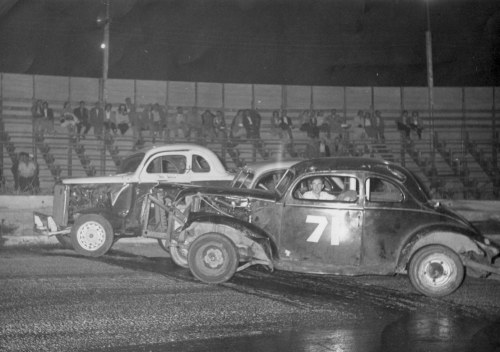
This track only lasted for the last part of the 1951 season. (Thanks to Dave Boon for this info). Crash in 1952 - Derek Middleton is the #71 The last edition of Pinecrest Speedway opened in May of 1952.
It was a tight quarter-mile track with both an inner and outer wall and was surrounded almost completely by covered seating. It ran Wednesday and Saturday nights in the early years. Admission that first year was $1 for adults and 50 cents for children.
Since Oakwood was a success for Cappy and Smith, they often advertised the track in 1952 as 'Oakwood Stadium presents Pinecrest'. The success of Oakwood carried over to the new Pinecrest for Cappy and Smith as crowds were often between 2500 and 4000 spectators.
Some of the top drivers in the early years were Ivan Moore, Jack Cook, Jack Burbridge, Glenn Schurr, Ben Lalomia, Tony Occhino and Ted Hogan. The 1953 season was dominated by Ivan Moore who won 10 features in a row on his way to winning $1000 as the Carling Points Champion. Cappy and Smith changed the track surface to concrete for the 1954 season and claimed it as 'Canada's only all-weather track'. Hurricane Hazel rolled through Toronto in 1954 and it hit Pinecrest, destroying about 400 feet of the west grandstand. Tutorial See Electrical Expert Pdf7. There were various special events - Ladies Races (called Powder Puffs), demolition derbies (Wreck-Um Races as they were often called), city races where drivers from one city would compete against drivers of another city, the Joie Chitwood Auto Daredevils and Midget races. The tight track led to a lot of big wrecks as roll-overs were a very common occurence. Usually the drivers were not hurt but some were not so lucky.
Bill Clemons of Mashawaka, Indiana was badly burned in practice for the 1957 International when his throttle stuck, slammed the wall and his car burst into flames. Clemons died a few weeks later. By the late fifties the cars became known as modified stock cars and were the beginnings of the modern supermodified.
Some new drivers entered scene in this era: Jack Greedy, Norm Mackereth, Jim Hallahan, Mac Bound, Dave Stephenson, Bill Cromb and Jerry Watson. Jim Hallahan in the #33 shows how the cars had progressed by the late 50's and early 60's. Part way through the 1959 season, the CNE drivers were kicked out of the CNE track on Tuesday nights to make way for the Toronto Argos. This began a tradition at Pinecrest for the next few years that brought the CNE drivers there on Tuesday nights after the football season started. This brought drivers such at Ted Hogan, Don Fleming, Charlie Greenlaw, John Shirtliff, Howie Scannell, Jimmy Howard and the return of Norm Mackereth who had left Pinecrest to race at the CNE. I n 1960 Pinecrest was purchased by Gerry Bisson of Ottawa. Bisson had been operating Lansdowne Park Speedway in Ottawa and later built Capital City Speedway in Stittsville (now known as Ottodrome International Speedway).
Go kart racing was also added in 1960. The 1962 season came to an early end when the Vaughan Township revoked Pinecrest's license due to not meeting some previous agreements. Things were sorted out in time to run the annual International race in September. Howie Scannell in the 1970's The 1963 season saw a big change at Pinecrest as the modified division was dumped in favour of Late Models. The modifieds (or super modifieds) were not completely gone though - once again the CNE drivers moved into Pinecrest on Tuesday nights once football season began.
The CNE had not made the switch to Late Models yet. With the switch to Late Models, some new drivers moved to the front at Pinecrest while some veteran drivers stayed. This era saw Jerry and Bob Watson, Phil Zampino, Vic Parsons, Jim Hallahan, George Reuffer, Ross Howes, Gord Dolphin, Ray Gullison, Jack Cook and Norm Lelliott as the top drivers. Another change in ownership for 1963 saw two familiar faces return - original owners Joe Cappy and Norm Smith had taken over again. The west grandstands were build for the 1963 season and seated approximately 3500.
Wednesday night racing was added for 1964. Pinecrest had an claiming rule in the mid 1960's. It was originally $500 for the whole car minus the tires and was later changed to $375 for the engine minus the carburator, clutch and housing. The 1968 season opened with $10,000 in improvements to Pinecrest including a new 3 foot outside wall and better pit lighting. The purse that year was $1700. Top 20 Hindi Serial Jodi.
A driver who all 3 of his races would take home $300. Also for 1968, the claming rule was dropped.
Another ownership change at the end of 1969 season when Norm Smith sold his share of Pinecrest to Joe Cappy who in turn. 1972 Aerial photo by Ian K. Woods sold the track to the DiCarlo family in February of 1972 for around $600,000. Rocco DiCarlo became the track promoter. The final years of Pinecrest saw the big dollar Export 'A' Championship as a regular visitor. In addition, Carling Breweries sponsored the Red Cap points fund as they had for many years.
The Carling O'Keefe Championship made 4 visits in 1975. The crowds continued to be huge, often in the 10,000 - 15,000 range. Wednesay night racing returned in 1974, in addition to Saturdays.
Special features in those years included demolition derbies, stuntman Ken Carter, The Trans-Canada Hell Drivers, the Can-Am TQ Midgets, Media Races and Ladies Races. The Stocker Division was added in 1972 for older cars. The dominent drivers in the final years included Don Biederman, Tom Milligan, George Reuffer, Tom Cuzzilla, Doug Warnes, Bill Zardo, Phil Zampino, Norm Lelliott, Howie Scannell and Junior Hanley. Some of the top drivers in the Stocker division were John Fletcher Sr, George Simms, Lambert Yake and John Buchanan.
In early August of 1976 it was announced that the races on Aug 14 would be the last at Pinecrest. The land had been sold for about $2,000,000 and would be redeveloped for commercial uses. At the time, Rocco DiCarlo had plans to spend $600,000 to build a half-mile track at Jane and Rutherford (near what is now Canada's Wonderland) but nothing came of it despite rumours for several years (even as late as 1980). Tom Milligan won the last-ever feature at Pinecrest and was also the 1976 Track Champion. The Pinecrest drivers scattered to other tracks in Ontario such as Flamboro, Sunset and Westgate (now Peterborough Speedway). The closing of Pinecrest was the end for stock car racing in the Toronto area for fourteen years, when racing.
The track surface was ripped up and the grandstands torn down in the early spring of 1977. Today the site is covered with industrial buildings and nothing of the track remains.
The name 'Pinecrest' is still in use in the area by way of the Pinecrest Restaurant and Truck Stop, Pinecrest Motel and Pinecrest 2000 Auto Sales.